A Self-Guided Walking Tour of Bern's UNESCO-Listed Old Town

Few European capitals are as compact, as walkable, or as well preserved as Bern. The Swiss capital sits on a narrow peninsula inside a bend of the Aare, and that geography has shaped it for more than eight centuries: the city could only grow lengthways, so it grew in orderly rows of sandstone houses, covered arcades, and fountains set at regular intervals along the main streets.
The result is an Old Town that has changed remarkably little since the medieval period, and one that is best understood on foot. Nothing here is far from anything else. In half a day you can walk from the railway station to the river, climb a cathedral tower, stand where Einstein worked out the special theory of relativity, and look back across the whole city from a rose garden on the opposite bank.
This is a self-guided route through Bern's UNESCO-listed Old Town, in the order the streets naturally take you.
Why Bern's Old Town Is a UNESCO Site
Bern's Old Town was inscribed on the UNESCO World Heritage List in 1983. The citation is not about a single monument but about the whole ensemble: a medieval city plan that survived intact, rebuilt in sandstone after a major fire in 1405 and expanded westwards in clearly readable stages.
What makes it unusual is the consistency. The street layout, the arcades, the fountains, and the roofline all belong to the same long architectural conversation. Walking the length of the Old Town is effectively walking through the city's growth from the twelfth century to the sixteenth.
It is also a working city centre rather than a preserved museum quarter. The arcades are full of shops, the trams run through it, and the Swiss federal government sits at one end of it.
Before You Start
A few practical notes will make the walk more enjoyable.
- The route below runs roughly 2.5 kilometres end to end and takes two to four hours depending on how often you stop.
- It is almost entirely downhill from the station to the river, then uphill again if you finish at the Rosengarten.
- The cobblestones are uneven in places, so comfortable shoes matter more than the short distance suggests.
- The arcades keep you dry in rain, which makes this a reliable wet-weather option.
- Most of the walk is free; only the cathedral tower and the museums charge admission.
Begin at Bern railway station, which sits at the western end of the Old Town peninsula.
1. Bahnhofplatz and the Church of the Holy Ghost
Directly outside the station stands the Church of the Holy Ghost, one of Switzerland's most significant Protestant churches of the eighteenth century. Its restrained interior is a useful introduction to the city's Reformation history, which shaped Bern as decisively as any building here.
From the square, head east along Spitalgasse. You are now on the main axis of the Old Town, and you will follow it, under different street names, almost all the way to the river.
2. The Arcades
The first thing most visitors notice is that they are walking under cover. Bern's arcades run for roughly six kilometres, making them one of the longest covered shopping promenades in Europe.
They are not a modern convenience. The arcades developed as the ground floors of merchant houses were extended over the pavement, creating sheltered trading space that also widened the usable street. Look for the cellar doors set at an angle into the pavement: these open onto vaulted cellars that once stored goods and now hold bars, theatres, and small shops.
- Spitalgasse, Marktgasse and Kramgasse form the continuous main run.
- Side lanes such as Münstergasse are quieter and often more atmospheric.
- The arcades are at their best in rain or strong sun, when the contrast of light and shadow is sharpest.
3. Käfigturm
Where Spitalgasse becomes Marktgasse, you pass beneath the Käfigturm, the Prison Tower. It marked the city's western gate in the thirteenth century, before Bern expanded past it, and later served as a prison — which is how it acquired its name.
Its position is worth registering: every time you walk under one of these towers, you are crossing the line of an earlier city wall. Bern's towers are the fossilised edges of a city that kept outgrowing itself.
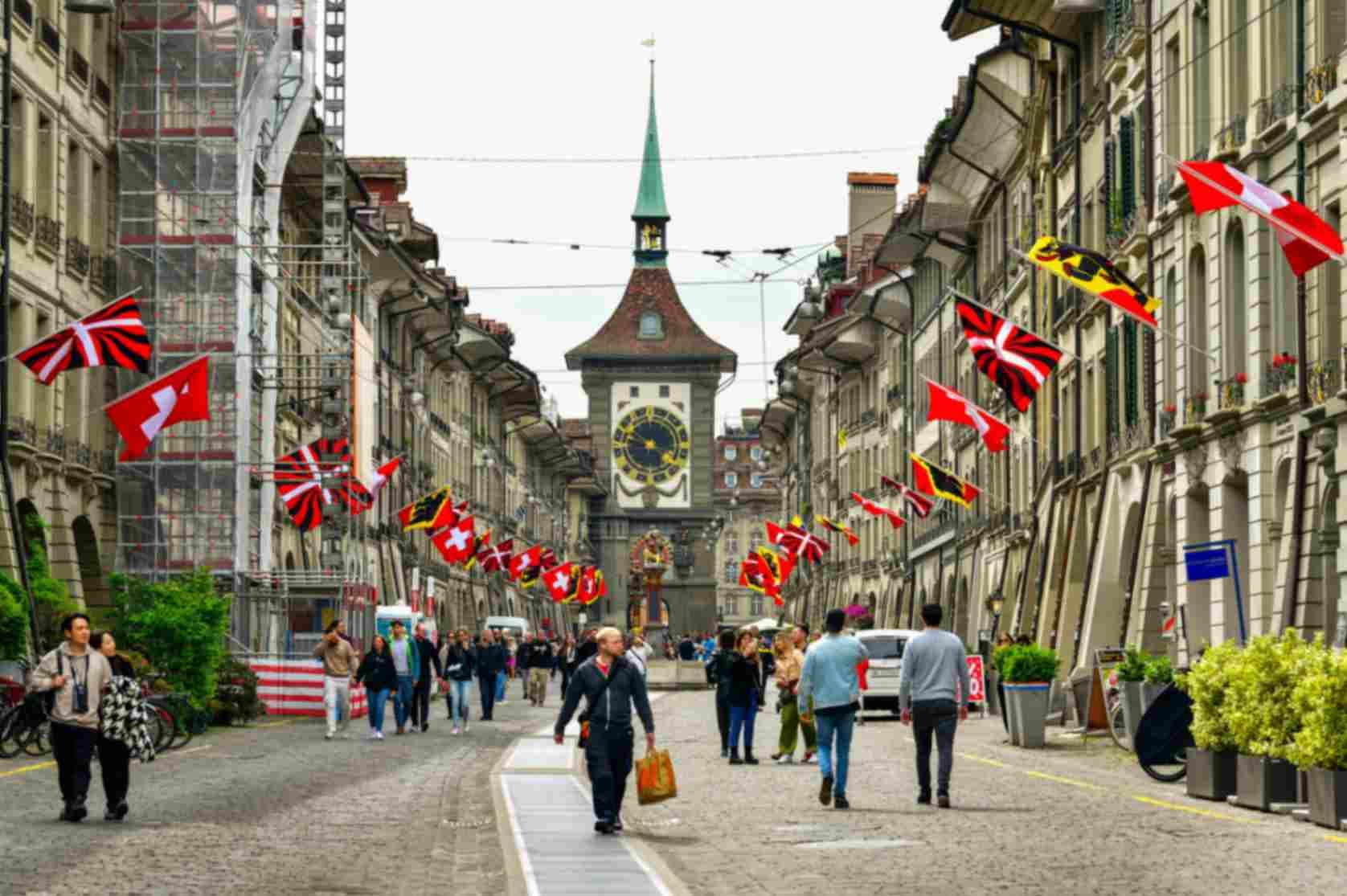
4. Zytglogge
A few hundred metres further east stands the Zytglogge, Bern's clock tower and the most photographed building in the city.
Like the Käfigturm, it began as a gate tower and was left stranded inside the city as Bern grew. Its astronomical clock dates from the sixteenth century and still works. A few minutes before each hour, a small mechanical procession of figures — a crowing rooster, a parade of bears, a jester — performs on the eastern face.
Arrive four or five minutes early and stand on the eastern side, on Kramgasse, to see the sequence properly. The performance is brief and easy to miss.
Guided tours of the clock mechanism run regularly, but places are limited and should be reserved in advance; check current times before you plan around one.
5. Kramgasse and the Einstein House
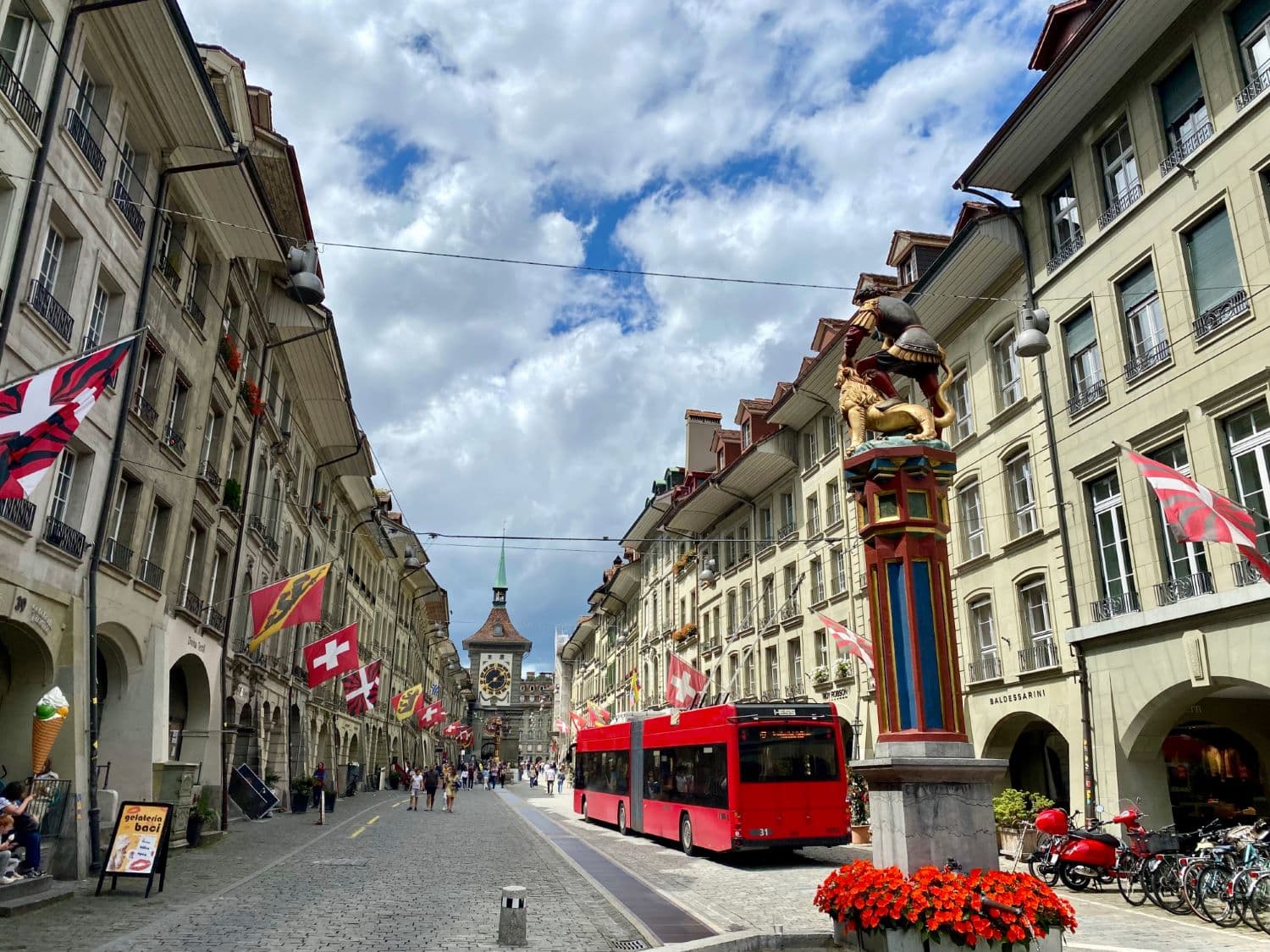
Kramgasse, immediately east of the Zytglogge, is the finest single street in Bern: broad, arcaded, and punctuated by fountains down the middle.
At Kramgasse 49, Albert Einstein rented a second-floor apartment between 1903 and 1905 while working as a clerk at the Swiss Patent Office. It was here, in what became known as his miracle year, that he published the papers that included the special theory of relativity. The apartment is now a small museum furnished in period style.
The building is unremarkable from the street, which is rather the point. Einstein was an unknown junior official living in an ordinary flat above an ordinary arcade.
6. The Fountains
Spaced along the main streets are eleven Renaissance fountains, most of them created in the sixteenth century by the sculptor Hans Gieng. They were originally the city's water supply; the sculpture was added to turn a utility into civic decoration.
Each figure carries a meaning, and together they form a kind of moral commentary running the length of the town.
- Zähringerbrunnen — an armoured bear honouring Bern's founder, Berchtold V of Zähringen.
- Gerechtigkeitsbrunnen — Justice, blindfolded, standing above the heads of a pope, an emperor, a sultan and a mayor.
- Kindlifresserbrunnen — the Ogre Fountain, whose unsettling figure has attracted competing explanations for centuries.
- Simsonbrunnen — Samson forcing open the jaws of a lion.
- Mosesbrunnen — Moses holding the tablets of the law, on Münsterplatz.
The water in the fountains is drinkable, and locals refill bottles at them throughout the summer.
7. Bern Cathedral
Turn south off Kramgasse onto Münstergasse and you arrive at Bern Cathedral, the Münster. Begun in 1421 and not completed until 1893, it is the largest and most important late-Gothic church in Switzerland.
The main portal carries an elaborate depiction of the Last Judgement, one of the few such sculptural groups in Europe to survive the Reformation largely intact — it was spared when the interior was stripped in 1528.
The tower is the tallest church spire in Switzerland at just over 100 metres. The climb is a little over 300 steps up a narrow spiral staircase, and the view from the top takes in the whole Old Town, the loop of the Aare, and on clear days the Bernese Alps on the horizon.
If you only pay for one thing on this walk, make it the tower.
8. Münsterplattform
Beside the cathedral is the Münsterplattform, a terrace built out on the retaining wall above the river. It is a quiet, tree-shaded square with a café, a chess set painted on the ground, and a view straight down to the Aare some thirty metres below.
It is the best place on the route to sit for a while, and the first point where you properly understand the city's geography: the river is not beside Bern, it is beneath it, on three sides.
9. Nydegg and the Aare
Continue east and the Old Town narrows and drops towards the river. This is the oldest part of Bern, the Nydegg quarter, built around the site of the original castle.
Cross the Untertorbrücke, the city's oldest stone bridge, or the higher Nydeggbrücke for the better view. On the far bank is the BärenPark, where Bern's bears — the animal on the city's coat of arms and the origin of its name — live in an open enclosure along the riverside.
In summer, you will see locals floating down the Aare with the current, a long-standing Bernese habit. The river is fast and cold, and it is not something to attempt casually.
10. The Rosengarten
The climb up from the bridge to the Rosengarten takes about ten minutes and is the only real effort on the route.
The former cemetery is now a public rose garden, and it offers the classic view of Bern: the whole Old Town laid out on its peninsula, the cathedral spire rising above the tiled roofs, the Aare curving around it all. Late afternoon light is best.
This is where the walk ends. A bus runs back down to the city centre if you would rather not retrace the hill.
A Short Detour: The Federal Palace
If you have time, the Bundeshaus — the seat of the Swiss federal government — sits just south of Bärenplatz, a two-minute walk off the main route near the start.
The terrace behind it looks south across the river towards the Alps, and the square in front hosts a market several days a week. Free guided tours of the building are available when parliament is not sitting; these must be booked ahead.
How Long Does the Walk Take?
The route works at several speeds.
- Ninety minutes — the main street from the station to the Nydegg bridge, without stops.
- Half a day — the same route with the cathedral tower, the Einstein House, and a pause on the Münsterplattform.
- A full day — adding the Federal Palace, one of the museums on Helvetiaplatz, and a slow lunch.
Most visitors find half a day about right for a first visit.
The Best Time to Walk It
Bern rewards visitors in every season, and the Old Town changes character noticeably through the year.
Spring
The Rosengarten comes into bloom from late spring, and the terraces fill up. Streets are lively without being crowded.
Summer
The arcades provide shade, the fountains are in constant use, and the riverbanks become the city's living room. This is the busiest season.
Autumn
Arguably the best light of the year for photography, with low sun striking the sandstone. The onion market in late November is one of Bern's biggest annual events.
Winter
Cold, quiet, and atmospheric. The arcades come into their own, and the Christmas markets on Waisenhausplatz and Münsterplatz run through December.
Practical Tips
- Start early if you want photographs without crowds; the main streets are quiet before nine.
- Wear shoes you can walk on cobblestones in for two hours.
- Carry a bottle and refill it at the fountains.
- Sunday is the quietest day, but most shops in the arcades will be closed.
- The Old Town is compact but hilly at its eastern end; the bus back from the Rosengarten is a reasonable choice.
- Buy the cathedral tower ticket at the base of the tower rather than planning around a fixed time.
Where to Pause
The walk passes several natural stopping points, and building one or two into the route makes it considerably better.
- The Münsterplattform for a coffee with a view over the river.
- The terraces on Bärenplatz, busy and central, good for people-watching.
- Kornhauskeller, a vaulted former granary cellar beneath Kornhausplatz.
- The riverside path below Nydegg, quiet and almost always empty.
Final Thoughts
Bern is often treated as a stopover between Zurich, Interlaken and Lausanne, and it suffers from the comparison: it has no lake, no famous mountain, and no single landmark that carries a postcard on its own.
What it has instead is coherence. Very few cities of this age have kept their medieval plan so completely, and almost none have kept it as a functioning centre rather than a preserved quarter. Walking the length of the Old Town, from the station to the river, is the clearest way to see how a European city actually grew — in stages, around a river, one row of sandstone houses at a time.
It takes half a day, costs almost nothing, and is the best introduction to the Swiss capital there is.